SKU:
17PCS Professional Luxury High Quality Daily Ebony Handle with Bag Full Makeup Brushes Set
17PCS Professional Luxury High Quality Daily Ebony Handle with Bag Full Makeup Brushes Set
Couldn't load pickup availability
17-Piece Professional Makeup Brush Set
One set. Every tool. No compromises on materials.
Every piece in this set was built around a single question: what does this specific brush need to do, and what material makes it do that best?
The answer, for 14 of the 17 brushes, is ultra-fine tapered synthetic fiber — the correct choice for any product that carries powder, liquid, or cream, because synthetic fiber transfers, not absorbs. For two of the eyeshadow brushes, it's XGF-grade goat hair sourced from a specific part of the animal — because powder blending at the crease demands a surface texture that synthetic fiber can't replicate. And for the silkworm brush, it's pony hair — the only bristle material that delivers the controlled, gradual shimmer release this technique requires.
Every brush in the set shares the same ferrule and handle: solid copper, nickel-electroplated, double-crimped. Solid ebony wood, CNC-turned to tolerance, hand-sanded to 800 grit.
17 brushes. 3 fiber types. One standard of construction throughout.
§ THE MATERIALS
What Every Brush in This Set Is Built From
I. The Ferrule — Solid Copper, Nickel-Electroplated
Most ferrules on the market are aluminum. Ours are solid copper. This is not a cosmetic choice.
| Our Copper Ferrule | Typical Aluminum Ferrule | |
| Hardness | ~3–10× harder than aluminum | Soft; deforms under pressure |
| Density | 8.96 g/cm³ — satisfying weight in hand | 2.7 g/cm³ — lightweight, cheap feel |
| Corrosion resistance | Copper base + nickel plating = multi-layer protection | Anodized surface only; grays over time |
| Crimp precision | Seamless, high-force double crimp achievable | Prone to cracking under high crimp force |
| Surface finish | Mirror-bright after nickel plating | Dull matte or painted |
Here's how the copper gets its armor. After the tube is formed and shaped, it enters a multi-stage electroplating line. First, the raw copper surface is degreased and acid-activated — two steps most budget manufacturers skip, and the reason their plating peels. Then a base copper strike layer is deposited, giving the subsequent nickel layer a molecularly bonded foundation to grip. The nickel plating itself is applied at a controlled thickness of 5–15 microns, forming a dense, corrosion-resistant shell. The outermost layer — a bright chrome or gold finish — is what you see and feel: hard, reflective, and immune to the tarnishing that makes aluminum ferrules look cheap within months.
Once the bristle knot is set inside the ferrule, the tube is double-crimped: two precisely aligned compression passes on opposite sides of the ferrule, creating a mechanical lock around the hair bundle that glue alone could never achieve. Then, the joint between the ferrule and the handle is sealed with structural epoxy resin — a physical waterproof barrier that stops wash water from wicking into the wood and causing the handle swelling and cracking that ruins so many "premium" brushes.
II. The Handle — Solid Ebony Wood
We use ebony. Not ebony-finish. Not ebony-stained beech. Solid ebony — one of the densest, hardest, and most storied woods on earth.
| Ebony (Diospyros spp.) | Common Beech Handle | |
| Janka Hardness | 3,220 lbf | ~1,300 lbf |
| Density | 1,089 kg/m³ | ~720 kg/m³ |
| Sinks in water? | Yes — denser than water | No |
| Natural color | Deep black from within the heartwood | Pale; requires dyeing |
| Surface pores | Extremely tight; near-zero grain pores | Visible grain; requires lacquer to seal |
| Natural antimicrobial | High tannin content; naturally inhibits bacteria | Requires treatment |
Ebony is hard enough that it dulls the CNC cutting tools that shape it — which is why most manufacturers don't bother. We do, because nothing else handles the way ebony handles. Its density of 1,089 kg/m³ means it is literally heavier than water — drop a piece into a glass and it sinks. That same density is what gives this handle its distinctive heft: not heavy enough to fatigue your hand, but substantial enough to tell you, the moment you pick it up, that this is not a toy.
The color is not dye. It is the heartwood of the tree — the oldest, most compressed rings at the core, black because of centuries of mineral and tannin accumulation. A beech handle stained black will fade and streak at the edges within months of regular washing. This handle won't. The color goes all the way through.
Every blank is CNC-turned to a diameter tolerance of ±0.1 mm so it fits the copper ferrule with zero play, then hand-sanded through progressive grits — 120, 240, 400, and finally 800 — until the surface reaches a near-glassy smoothness without a single coat of lacquer. Each finished handle is individually weighed; any piece outside our weight specification is rejected. The result is a set of 17 brushes that feel identical in the hand, because they are.
III. The Bristle Philosophy — Why We Use Three Different Fiber Types
Synthetic fiber (14 brushes): Ultra-fine tapered synthetic fibers, each engineered to a tip diameter of less than 0.01 mm. The sealed, smooth surface means powder, liquid, and cream products sit on the bristle and transfer directly to skin — not absorbed into a porous fiber shaft. Every fiber is graded to a tolerance of ±5 microns before assembly. Bristle knots are hand-sorted, hand-bundled, and set with cosmetic-grade epoxy adhesive — the same class used in medical-grade tool manufacturing. Every brush passes a mechanical shedding stress test before leaving the factory.
XGF-grade goat hair (2 brushes — Mid & Small Eyeshadow): ZGF is the upper tier of the goat-hair grading system (XGF / ZGF / HJF / BJF, finest to coarsest). The hair is sourced from the neck-to-shoulder junction of adult goats — the small area of the animal where fiber grows finest, straightest, and with the highest natural tip-split rate. Fiber diameter runs at approximately 12–15 microns — finer than cashmere (14–19 microns). We specify and test by seasonal batch; winter coats run coarser, spring fleece is finest. Every bundle is hand-sorted: misaligned tips removed, coarser outliers pulled. Only fibers that pass the fingertip test — that specific drag-and-spring you can only feel, not measure — make it into the brush.
Pony hair (1 brush — Silkworm Brush): Sourced from the mane region, where the fiber is finest and most uniform. Pony hair occupies a specific position between goat hair and squirrel in softness, with a controlled product-release characteristic that no synthetic fiber we tested could replicate for silkworm technique application.
§ CARE GUIDE
How to Keep Your Brushes Performing
Cleaning frequency: Brushes used with liquid or cream products (foundation, concealer) should be cleaned after every use. Brushes used with powder products can go 2–3 uses between washes.
How to wash: Run the bristle head under lukewarm water — never hot, which can loosen the epoxy adhesive and warp natural hair. Apply a small amount of mild brush cleanser or unscented baby shampoo to your palm, swirl the brush head gently until the water runs clear, then reshape the bristles and lay flat to dry. Never store brushes bristle-up while wet — water wicks into the ferrule and can cause handle damage over time.
What to avoid:
● Soaking the ferrule or handle in water
● Using alcohol-based cleansers on natural hair brushes (Mid Eyeshadow, Small Eyeshadow, Silkworm)
● Pulling or tugging at bristles when wet
● Drying upright while wet
Reshaping: After washing, gently reshape the bristle head with your fingers before laying flat. The hand-tied knot construction means these brushes will return to their original shape as they dry, provided they're not crushed against a surface.
Lifespan: With proper care, synthetic brushes in this set should retain full performance for 3–5 years of daily use. Natural hair brushes (goat and pony hair) are slightly more delicate and benefit from a conditioning brush soap every few months to maintain softness.
Makeup Bag
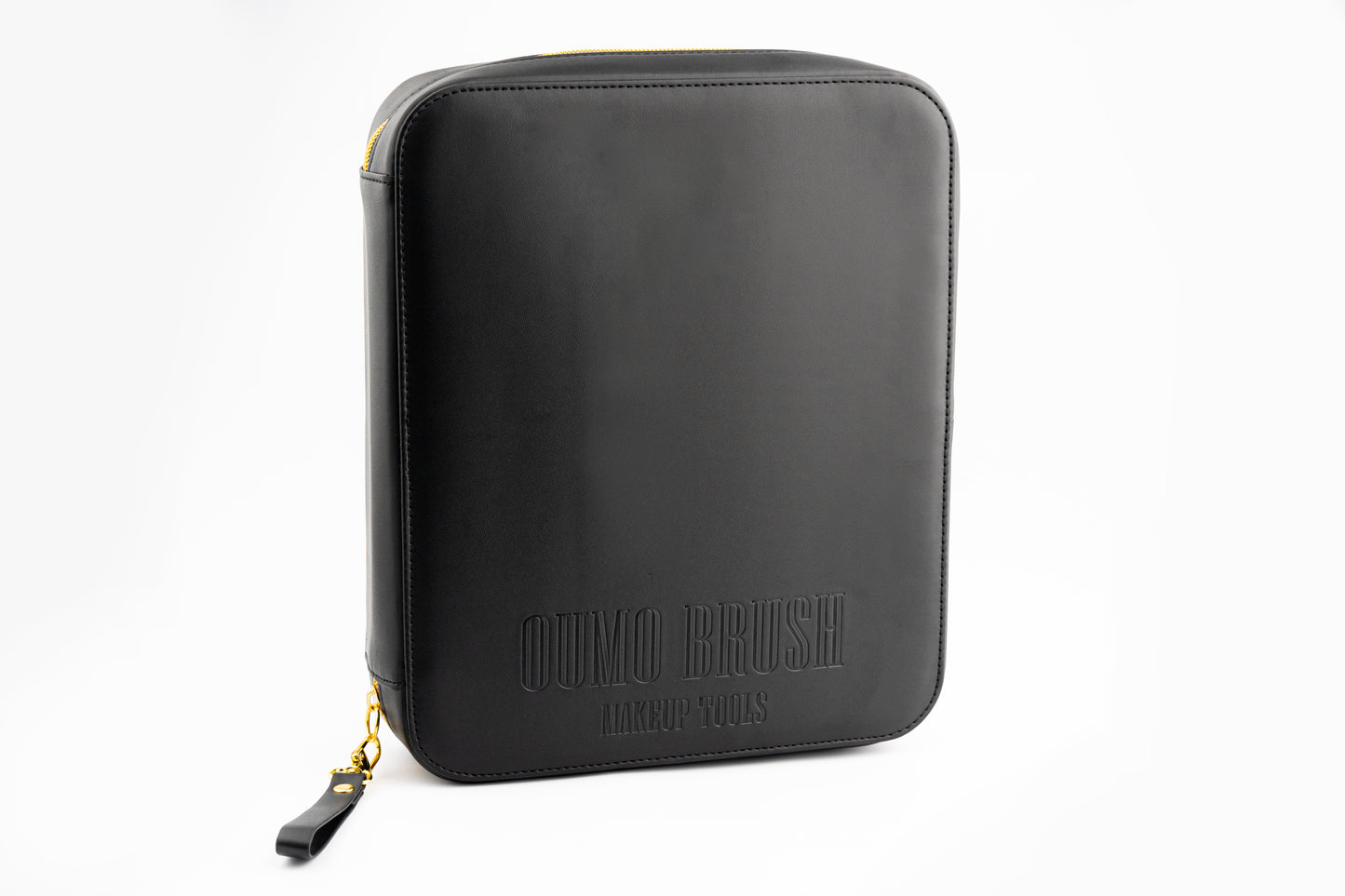
The shell is matte black PU leather — a surface that resists surface scratches, wipes clean, and doesn't pick up fingerprints the way glossy finishes do. It's not trying to look like animal leather. It's trying to look like what it is: a purpose-built professional tool case.
The OUMO BRUSH / MAKEUP TOOLS logo is pressed directly into the PU surface — an emboss, not a print. Printed logos wear, crack, and peel at the edges within months of regular use. An embossed logo is structural: it's pressed into the material itself, and it will still be there, crisp and deep, years from now.
The case is sized at 27.9 × 23.4 cm — large enough to house a full 17-piece brush set with room to breathe, compact enough to fit into a professional kit bag or a carry-on without negotiating for space.
The Zipper
The zipper is gold-tone metal, heavy-gauge, with a pull weight that tells you immediately it's not a budget component. It runs three sides of the case in a single continuous track — which means no corner stress points where cheaper cases split. The zipper pull is a solid metal loop, not a fabric tab. It won't fray, stretch, or pull apart from its attachment point.
A zipper is the most-used component on any case. We chose one that is rated for daily use at a professional frequency — not occasional weekend use.
§ Words Before You Open the Box
Seventeen brushes. Three materials, chosen deliberately. One ferrule system, built from the ground up. One handle, sourced from one of the densest woods on earth.
This is not a brush set designed to photograph well in marketing. It's a brush set designed to work — every day, wash after wash, year after year. The materials we chose are harder to source, more expensive to machine, and more demanding to assemble than the alternatives. That's the point.
If you ever look at a tool in this set and wonder whether we could have made it cheaper — we could have. We just didn't.
Share